
Invisalign may help with some bite concerns, but the answer depends on why your teeth meet the way they do. Moving teeth into a different position is not the same as changing the relationship between the upper and lower jaws. An assessment is needed to understand which changes are realistic for your mouth.
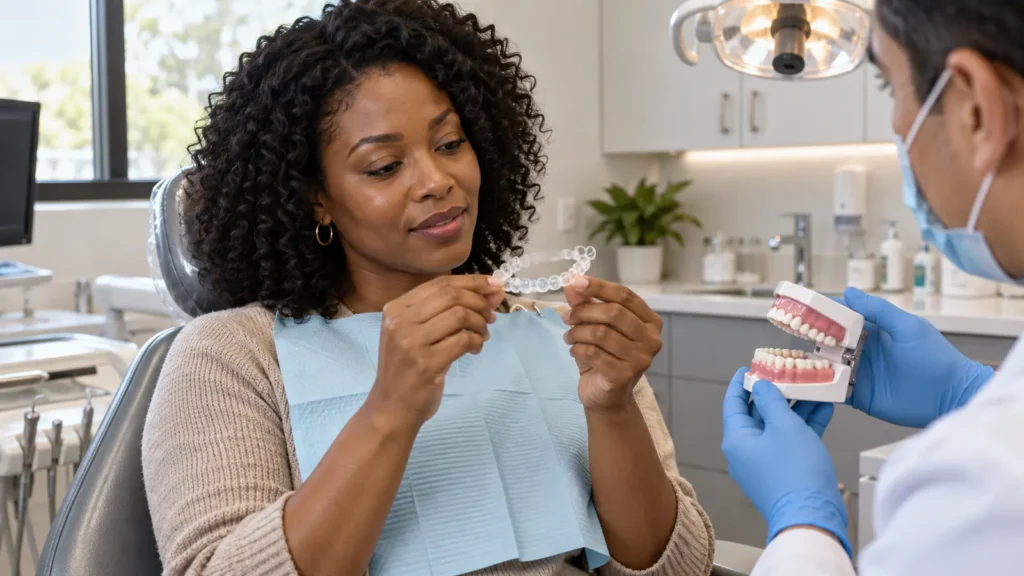
If you’re considering treatment as an adult, start with the problem you want to solve. You might be concerned about overlapping teeth, difficulty biting into food or a change you’ve noticed over time. An Invisalign dentist can help you sort out whether those concerns are related and what treatment, if any, is worth considering.
What does a bite problem mean?
Your bite describes how your upper and lower teeth come together. Teeth can look quite straight from the front while meeting unevenly at the sides or back. Equally, a tooth that looks slightly out of line doesn’t necessarily mean you have a significant functional problem.
A few terms often come up during a bite assessment:
- An overbite describes how much the upper front teeth overlap the lower front teeth vertically. Some overlap is normal; a deeper overlap may need closer assessment.
- An underbite describes a situation in which the lower front teeth sit ahead of the upper front teeth.
- A crossbite occurs when some upper teeth sit inside the lower teeth rather than outside them.
- An open bite means some opposing teeth do not meet when the mouth closes.
These descriptions are a starting point, not a diagnosis. Two people with an “overbite” may need very different advice because the tooth positions, jaw relationships and degree of overlap differ.
The American Dental Association’s explanation of orthodontics describes a healthy bite in terms of teeth that meet properly. That broader goal is why an assessment looks beyond the appearance of the front teeth.
Which bite concerns might clear aligners address?
Clear aligners apply planned forces to move teeth over a series of stages. In suitable cases, those movements can change how opposing teeth meet as well as how straight they look. Some adults with an overbite, underbite, crossbite or open bite may therefore be able to consider aligners.
The name of the bite concern doesn’t tell you whether Invisalign is appropriate, though. The amount and direction of movement matter. So do the teeth involved and the condition of the tissues supporting them.
For example, moving a few teeth that are tilted out of position is different from addressing a large difference between the upper and lower jaw. A treatment plan needs to account for that distinction rather than assuming every problem can be managed with aligners alone.
When asking about Invisalign at Petrolia Dental, describe what you’ve noticed in everyday life. “I can’t bite through a sandwich with my front teeth” gives the dental team more useful context than trying to identify your own bite type from an online photograph.
Why some adult cases need a different approach
Adults can have orthodontic treatment, but planning has to reflect the mouth as it is now. Previous dental work, missing teeth, gum health and the type of movement required may affect the options.
Your dentist may need to address active dental concerns before considering tooth movement. A crown, bridge or implant also becomes part of the planning conversation; existing restorations cannot simply be ignored because the aligners are removable.
Some bite concerns are mainly related to tooth position. Others involve the relationship between the jaws, or a combination of both. Depending on the findings, braces, a different treatment approach or an orthodontic referral may be discussed.
That isn’t a failure of the consultation. Understanding a treatment’s limits helps you decide whether its likely benefits match your goals. You should be able to ask what an option can reasonably change and what would remain unchanged.
Jaw pain deserves its own attention. It should not automatically be attributed to an uneven bite or used as a reason to promise orthodontic treatment. The National Institute of Dental and Craniofacial Research’s guidance on TMD explains that evidence does not support the belief that a bad bite causes temporomandibular disorders. Changing tooth position is not a guaranteed treatment for jaw pain.
What an Invisalign assessment can clarify
A useful assessment connects your concerns with the dentist’s findings. You can explain whether the issue is long-standing, whether your teeth have shifted after previous orthodontic treatment and whether you’ve noticed changes in chewing or comfort.
The dentist can then examine how your teeth meet and assess your oral health. Records or imaging may be recommended when needed to understand the situation and plan care. The exact assessment depends on the individual case.
Before deciding, you should understand:
- Which bite concern has been identified.
- Whether it is primarily related to tooth position, jaw relationships or both.
- What changes the proposed treatment aims to achieve.
- Whether other dental care or specialist input is needed first.
- What alternatives are available.
A digital preview, if used, can help explain a proposed plan. It isn’t a guarantee of the finished result. Ask how progress would be monitored and how the plan might change if your teeth don’t move as expected.
It’s also reasonable to separate your priorities. You may care most about biting comfortably, improving the appearance of particular teeth or keeping treatment manageable around work. Being specific helps the discussion stay focused on what matters to you.
What treatment asks of the patient
Removable aligners still require a consistent routine. You’ll need to follow your prescribed wear schedule, remove and care for them as directed, and attend the recommended review appointments.
Before starting, think about how that routine fits your day. Frequent snacks, long coffee breaks or irregular shifts aren’t reasons to rule treatment out, but they are worth discussing. The practical demands should be clear before you commit.
Tell the dental team if an aligner stops fitting properly, becomes damaged or is difficult to wear. Trying to force a tray into place or changing the sequence yourself can make it harder to understand what’s happening.
Treatment length varies with the case and how it progresses. An estimate is more useful when the dentist explains what it depends on rather than presenting a fixed finish date.
Retention is another part of the decision. Once active tooth movement is complete, retainers help maintain the new positions. Ask about that stage early so the plan includes what happens after the last aligner.
Questions to bring to a bite consultation
You don’t need to arrive knowing which treatment to request. A short list of questions can make the appointment more useful:
- What is causing the way my teeth meet?
- Which changes could aligners realistically achieve in my case?
- Would braces or another approach offer different advantages?
- Are there gum or dental concerns that should be treated first?
- How would you assess progress, and when might the plan need adjusting?
- What would retention and ongoing care involve?
Ask for explanations in everyday language. If the recommendation doesn’t seem to address your main concern, say so. A good decision starts with understanding the proposed goal, the limitations and what you would need to do.
Frequently asked questions
It may help in selected cases, but “overbite” covers different degrees and causes of overlap. A dentist needs to assess the teeth and jaw relationships before explaining whether aligners are suitable and what improvement may be possible.
No. A visible difference does not automatically mean treatment is necessary. The recommendation depends on the findings, any functional concerns, oral health and your goals.
Aligners move teeth; they do not make every underlying jaw difference disappear. A significant skeletal concern may need a different approach or specialist assessment, even if some tooth movement is possible.
There is no guarantee that orthodontic treatment will relieve jaw pain. Pain in the jaw, face or chewing muscles needs an appropriate assessment rather than an assumption that tooth alignment is the cause.
Existing dental work does not automatically rule it out. Its condition, location and the proposed tooth movements need to be considered as part of your treatment plan.
Discuss your questions with Petrolia Dental
If you’re unsure whether the way your teeth meet could be addressed with clear aligners, bring that question to an assessment. Petrolia Dental in Terwillegar Heights, South Edmonton, can discuss your concerns and the next steps for evaluating your options.
You can contact Petrolia Dental to ask about an appointment. You don’t need to know the name of your bite concern before starting the conversation.